Applications Engineer Rob Philpot on BESS Modelling: Data, Assumptions and Battery Degradation
Blog
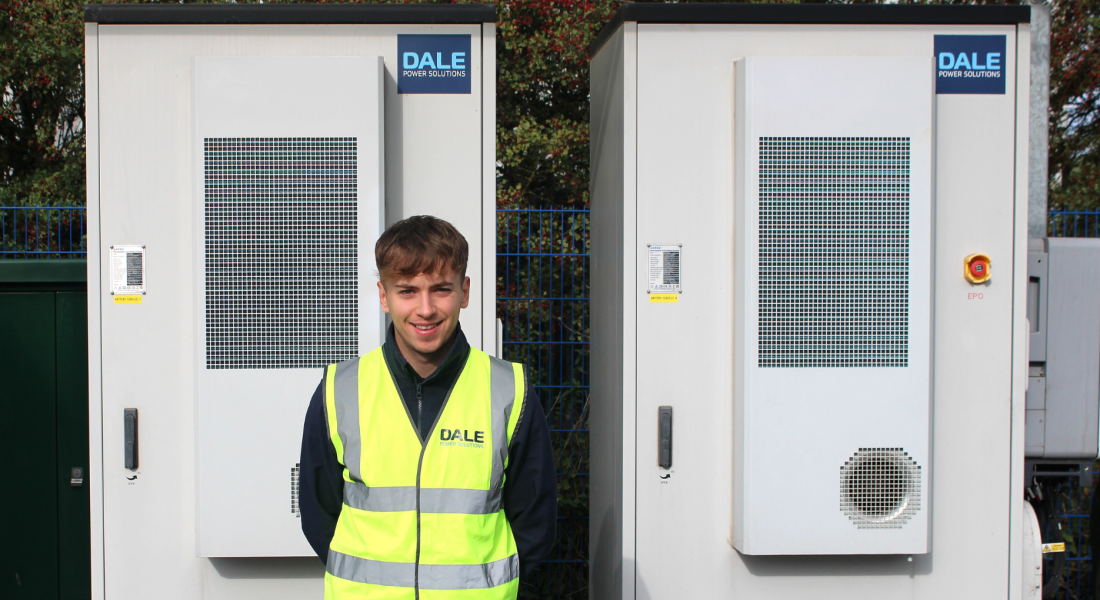
Rob Philpot is an Applications Engineer on the Battery Storage and Renewables team at Dale Power Solutions. He uses battery energy storage system (BESS) modelling to help businesses understand how a proposed battery could perform, from identifying an appropriate system size to estimating long-term cost savings, carbon savings and payback.
Before joining Dale, Rob earned a degree in Mathematics and a master’s degree in Transport Engineering, and after eight months at Dale, now applies the analytical and modelling skills he learnt at university to real BESS projects.
Rob uses modelling to translate customer requirements and priorities into BESS proposals, drawing on electricity bills, half-hourly energy usage data, and details of current or planned renewable assets, tariffs, and grid import limits to model long-term cost and carbon savings, payback periods, and more. He uses this information to run a feasibility study and create an initial project proposal, depending on what data the customer can provide.
As more processes and infrastructure become more electrified, including the rise of Electric vehicles and the push for Net Zero, customers increasingly prioritise:
Reducing energy costs
Optimising grid import allowance
Lowering carbon emissions
Making greater use of existing or planned on-site renewable generation.
The table below presents the ideal BESS modelling inputs and explains why each piece of information matters.
BESS modelling input | Why it matters |
Half-hourly consumption data | Shows the operating pattern for how much electricity the site uses and when. Important for modelling optimal battery cycles and usage strategies |
Electricity tariff | Determines the potential value of shifting electricity consumption with a BESS |
Grid import/export limits | Identifies site power constraints and how a BESS could alleviate some of this |
Existing/planned renewables | Shows how stored renewable generation could be used and allows the battery sizing to account for future site growth |
Battery degradation | Provides a more realistic long-term performance estimate, which will be explained in more detail later in the article. |
Describing his role in the process, Rob says:
My job is to understand what the customer wants and needs, what information we have available and what might be of interest to them. I look at the cost, how much money the system could save the customer and the overall opportunity.
Through modelling, the feasibility study identifies the optimal:
BESS charging and discharging cycles
BESS size
Project payback period
Cost and carbon saving potential.
As the project moves forward, Rob can provide more technical details or update the model as new information comes in. The model also accounts for factors such as the system's installation location, the site's electrical setup, and switchgear requirements.
Learn more about the wider role battery storage can play in business decarbonisation in our article, How Battery Energy Storage Supports the UK’s Net Zero Transition.
After college, Rob moved to Newcastle to earn a BSc in Mathematics. He then completed a master’s in Transport Engineering, where he could use maths to solve real-world problems. Reflecting on the transition from mathematics to engineering, he explains:
Mathematics can be quite abstract because it’s very broad and includes some highly theoretical areas. Transport Engineering allowed me to use mathematics in real-world scenarios.
Rob chose to go to university instead of starting his career with an apprenticeship. He sees the value in early work experience but feels university helped him grow personally and academically:
University helped me develop as a person. Moving away helped me grow, make friends in other places and broaden my horizons.
Rob believes that both university and apprenticeships are good ways to get into engineering. For him, though, university felt like the right choice after sixth form.
A model is only as reliable as the information and assumptions it uses, assumptions being estimates about current and future conditions. A customer's electricity tariff is one of the most important factors, along with energy market assumptions for projections over five years or more.
The large financial benefit of a BESS depends on the difference between variable or time-of-use tariff prices. If a customer’s electricity tariff information isn’t available or can’t be shared, Rob uses a suitable, estimated benchmark.
Fixed, time-of-use, and variable tariffs are defined below:
Fixed tariff: The agreed unit price remains fixed for the contract period, although other bill components may still vary.
Time-of-use tariff: Electricity costs vary across defined periods, with lower overnight prices and higher peak prices.
Variable tariff: The unit rate may change over time in line with the supplier’s pricing terms or wider market conditions.
Even a small difference in the assumed tariff can significantly affect projected savings when applied over thousands of half-hourly periods. The team therefore takes a careful approach to give a realistic projection based on the information they have access to.
Assumptions regarding the energy market include:
Future electricity costs
Inflation
Potential Capacity Market revenue.
Long-term forecasts are always less certain because markets, costs, and site needs can change. As a result, Dale Power Solutions typically models savings over a 15-year period. This helps customers see the potential value once their initial investment is made, without making uncertain predictions. On the reasoning behind this timeframe, Rob says:
We want to give customers more than just the short-term figures.
Modelling can’t predict every future operating condition, but it does provide an informed assessment based on the available information. Rob adds:
You can never know exactly how something will perform until it has actually been installed and is operating. But modelling allows us to produce the best possible estimate beforehand.
Every site has a unique electricity demand profile. Sites may have different operating hours, demand patterns, tariffs, and grid restrictions, all of which can affect the modelling process and outcomes.
Renewable generation and other on-site technologies add more detail to a model. Wind generation, solar PV, and combined heat and power systems may require different approaches. Highlighting the need to adapt the modelling process, Rob explains:
Sometimes we have to work out how to represent those factors within the software or find a slightly different way of modelling the site.
Each modelling process and output needs to match each customer’s site, rather than using a standard process.
Battery degradation is the gradual reduction in the amount of energy a battery can store and deliver as it ages and completes more charging cycles. Describing the effect, Rob notes:
The more times you charge and discharge a battery, or cycle it, the more its usable capacity gradually reduces.
Battery degradation is a normal characteristic of battery technology. For lithium-ion batteries, a thin protective layer called the Solid Electrolyte Interphase (SEI) forms on the anode during the first charge. Over time, this layer grows, uses active lithium and reduces the battery’s ability to hold and deliver energy. Rob compares this to mobile phone batteries, which will not hold the same level of charge after several years of regular use.
It’s important for BESS modelling to account for this gradual loss of capacity, rather than assuming a battery will always maintain its original performance. By incorporating degradation into the model, customers gain a clearer, more realistic idea of how the system might perform over time.
Rob says he approaches his career by taking “one game at a time” and focusing on the next chance to grow.
Rob’s career, from transport safety modelling to battery storage, shows how mathematical and analytical skills can be applied across different fields. His work helps ensure BESS proposals fit each site and provide a clear picture of system size, potential savings, and commercial value.
If you’re interested in a career in engineering, battery storage, or renewable energy, check out our Careers Page or email [email protected] to enquire about current opportunities at Dale Power Solutions.
An initial model can be created using an electricity bill, half-hourly electricity consumption data and information about the site’s existing or planned renewable assets. Details of grid import or export restrictions can also help strengthen the assessment.
Half-hourly data records how much electricity a site imports during 30-minute periods. It helps show when electricity demand rises and falls across the day, week and year.
The tariff determines how much the site pays for electricity at different times. This affects the potential value of charging a battery during lower-cost periods and using the stored electricity when prices are higher.
Modelling provides an informed estimate based on the site data and assumptions available at the time. Actual performance may be affected by future changes to energy prices, site demand, operating patterns and other conditions.