The Impact of Major Sporting Events on Energy Usage: the 2026 World Cup Energy and Formula 1’s Journey to Net-Zero
News
Major sporting events show how energy demand, infrastructure and sustainability intersect, from millions of football fans switching on kettles at halftime to global motorsport championships cutting carbon emissions. During England's 2026 World Cup fixtures, the National Energy System Operator (NESO) has predicted demand could rise by up to 800MW, as viewers use kettles and appliances during halftime and after matches. Formula 1 is also growing in popularity among 18-34-year-olds, with more than 4 million viewers watching its live 75th anniversary event at The O2 in 2025.
These short-term spikes highlight an ongoing challenge for energy providers. Electricity supply and demand must remain balanced in real time, meaning additional generation capacity often needs to be available at short notice. As the UK's electricity network evolves to accommodate growing levels of renewable generation, Distribution Network Operators (DNOs), Independent Connection Providers (ICPs) and wider grid modernisation initiatives are helping improve the resilience and flexibility of the power system.
Flexible power generation solutions, including standby and temporary generation, play an important role in supporting grid resilience during periods of rapidly changing demand.
England's opening match against Croatia was forecast to create a demand surge of at least 800MW. This would surpass the 600MW increase recorded during England's 1966 World Cup victory.
The most dramatic example of World Cup-related electricity demand remains England's 1990 semi-final against West Germany. Following England's penalty shootout defeat, demand surged by approximately 2,800MW as millions of viewers simultaneously switched on kettles and household appliances at the equivalent of more than one million kettles being switched on at once. These spikes are often referred to as "TV pickups" and remain one of the most recognisable examples of how collective consumer behaviour can influence electricity demand on a national scale.
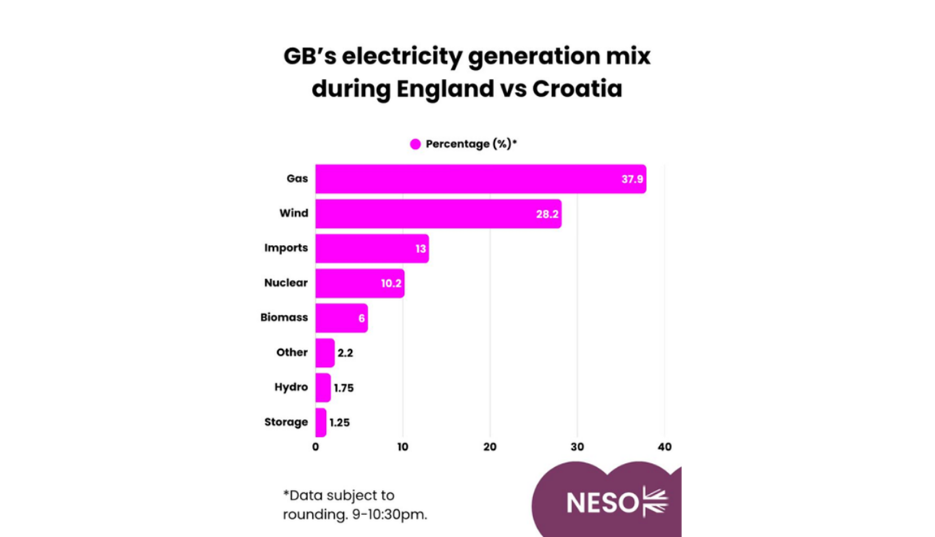
The England versus Croatia match on 17 June provided an interesting snapshot of the UK's modern electricity mix. During the game, NESO reported a 500MW increase in electricity demand at halftime and a further 170MW increase at fulltime as supporters headed to kitchens across the country.
At the time of the match, Britain's electricity was being supplied by a diverse mix of generation technologies:
Generation Source | Share of UK Electricity Mix |
Gas | 37.9% |
Wind | 28.2% |
Imports | 13% |
Nuclear | 10.2% |
Biomass | 6% |
Other | 2.2% |
Hydro | 1.75% |
Battery Storage | 1.25% |
While gas remained the largest single source of electricity generation, renewable technologies such as wind contributed more than a quarter of total generation. Battery Energy Storage Systems (BESS) also played a role in supporting the grid, highlighting the growing importance of storage technologies as renewables increase.
The ability to manage sudden demand spikes during events such as the World Cup relies on a combination of generation technologies, storage assets and grid balancing services working together to maintain system stability.
While the World Cup creates temporary increases in electricity demand, it also raises questions around sustainability. The 2026 FIFA World Cup is the largest tournament in the competition's history, featuring 48 teams, 104 matches and venues spread across the United States, Canada and Mexico.
According to Scientists for Global Responsibility (SGR), the tournament could generate almost nine million tonnes of CO₂e, potentially making it the most carbon-intensive World Cup ever held. SGR estimates this is equivalent to the annual emissions of approximately 6.5 million average British cars.
However, the tournament's use of existing NFL and major sporting venues represents a notable shift away from the extensive stadium construction programmes seen at some previous World Cups, demonstrating how infrastructure reuse can help reduce environmental impact.
While the World Cup demonstrates how major sporting events can create significant short-term pressure on electricity networks, it also raises a broader question: how can global sporting events reduce their long-term environmental impact?
Like the World Cup, Formula 1 operates on a global scale. The sport continues to attract growing audiences, particularly among younger viewers. Formula 1's 75th anniversary event at London's O2 Arena attracted more than 4 million viewers, setting a record for a live Formula 1 event. Unlike the 2026 FIFA World Cup, however, Formula 1 has placed a significant emphasis on measuring and reducing its environmental impact.
Formula 1 recently announced that it has reduced its carbon footprint by 35% compared to its 2018 baseline and remains on track to achieve its Net-Zero 2030 target.
This reduction has been achieved through a range of initiatives, including:
The adoption of Hydrotreated Vegetable Oil (HVO) and sustainable aviation fuels
Increased use of solar power
Deployment of battery energy storage systems
More efficient logistics and freight operations
Improvements to event operations and infrastructure
Formula 1's approach demonstrates that reducing emissions does not rely on a single technology. Instead, it requires a combination of solutions tailored to operational requirements.
Formula 1 is not alone in pursuing ambitious sustainability targets. Across the sporting world, organisers are increasingly looking for ways to reduce emissions while maintaining world-class events.
The Paris 2024 Olympic Games set out to halve their carbon footprint compared to previous editions of the Games. Final figures showed emissions of approximately 1.59 million tonnes of CO₂, around half the average emissions of both London 2012 and Rio 2016. This achievement was supported by the use of existing and temporary venues, which accounted for 95% of competition sites, alongside low-carbon construction practices and renewable energy procurement. Paris 2024 also sourced 98.4% of its electricity from certified wind, solar and hydroelectric providers and avoided the use of diesel generators for electricity wherever possible.
Wimbledon has committed to achieving net-zero operational emissions by 2030 and has introduced a range of environmental measures, including the elimination of single-use plastics and the redistribution of surplus food. During the Championships, approximately 1,000kg of surplus food is donated to charities rather than sent to waste.
UEFA Euro 2024 was designed to be the most sustainable European Championship to date, supported by a €30.6 million investment in sustainability initiatives. Importantly, no new stadiums were constructed for the tournament, with existing infrastructure used throughout. UEFA also clustered group-stage matches into regional hubs, reducing air travel by an estimated 75% compared to Euro 2016.
While each event faces different operational challenges, a common theme is emerging that event organisers are increasingly recognising that sustainability is not achieved through a single initiative but through a combination of measures, including renewable energy, energy storage, sustainable fuels, efficient logistics and the intelligent use of existing infrastructure.
The table below highlights some of the most significant energy demand and sustainability statistics from major sporting events around the world.
Event | Key Energy Statistic |
FIFA World Cup 2026 (England Matches) | UK electricity demand forecast to increase by up to 800MW during England fixtures as millions of viewers tune in simultaneously. |
FIFA World Cup 2026 (England vs Croatia) | Electricity demand increased by 500MW at halftime and a further 170MW at fulltime as supporters used household appliances. |
FIFA World Cup Semi-Final 1990 (England vs West Germany) | Generated a record 2,800MW electricity demand surge following the penalty shootout. |
Formula 1 | Reduced carbon footprint by 35% compared to its 2018 baseline and remains on track for Net-Zero 2030. |
Paris 2024 Olympics | Emitted 1.59 million tonnes CO₂e, approximately half the average emissions of London 2012 and Rio 2016. |
Wimbledon Championships | Committed to achieving net-zero operational emissions by 2030 while reducing waste and single-use plastics. |
UEFA Euro 2024 | Reduced tournament-related air travel by an estimated 75% compared to Euro 2016 through regionalised scheduling. |
Major sporting events demonstrate both the opportunities and challenges facing modern energy. On one hand, grid operators must be prepared to manage significant fluctuations in electricity demand. On the other hand, event organisers are increasingly under pressure to reduce emissions through renewable energy, energy storage, sustainable fuels and smarter infrastructure planning.
The examples explored throughout this article show that the future of sustainable sport depends on a two-pronged approach: resilient energy systems capable of responding to changing demand, and meaningful long-term action to reduce environmental impact. As sporting events continue to grow in scale and global reach, the relationship between energy demand, energy resilience and sustainability will only become more important.
The same principles apply across industry, where organisations are looking to improve energy resilience while reducing carbon emissions. Dale Power Solutions supports this transition through Battery Energy Storage Systems (BESS) and HVO-compatible generator technologies.
How much electricity does the World Cup use?
Electricity demand can increase significantly during major World Cup matches. NESO forecast that England's 2026 World Cup fixtures could increase UK electricity demand by up to 800MW as millions of viewers simultaneously use kettles, appliances and lighting.
Why do football matches cause electricity demand spikes?
Electricity demand often rises during halftime and immediately after matches when large numbers of viewers use household appliances at the same time. During England's 1990 World Cup semi-final against West Germany, electricity demand surged by approximately 2,800MW following the penalty shootout.
How is Formula 1 reducing its carbon footprint?
Formula 1 has reduced its carbon footprint by 35% compared to its 2018 baseline and is targeting Net-Zero by 2030. Key initiatives include the use of HVO and sustainable fuels, battery energy storage systems, solar power, and more efficient logistics operations.
What role does battery energy storage play during major sporting events?
Battery Energy Storage Systems (BESS) help improve grid stability by storing electricity when supply is abundant and releasing it when demand increases. As renewable energy generation grows, battery storage is becoming increasingly important for balancing electricity networks during periods of peak demand.

How Can Businesses Increase Site Power Capacity? The Role of Battery Energy Storage in Net-Zero Strategies

International Women in Engineering Day 2026: Recognising Women in Engineering, Project Management and Leadership at Dale Power Solutions

Dale Power Solutions Expands Critical Power and Life-Safety UPS Ranges with GTEC Europe