Grid Modernisation, Renewables, DNOs, ICPs and Dale’s Role: Q&A with Sam Messruther
Article
As the UK moves towards a more electrified and renewable-powered future, the pressure on grid infrastructure continues to grow. Rising demand from electric vehicles, AI, data centres and digital infrastructure is placing increasing strain on a network originally built for a very different level of electricity consumption.
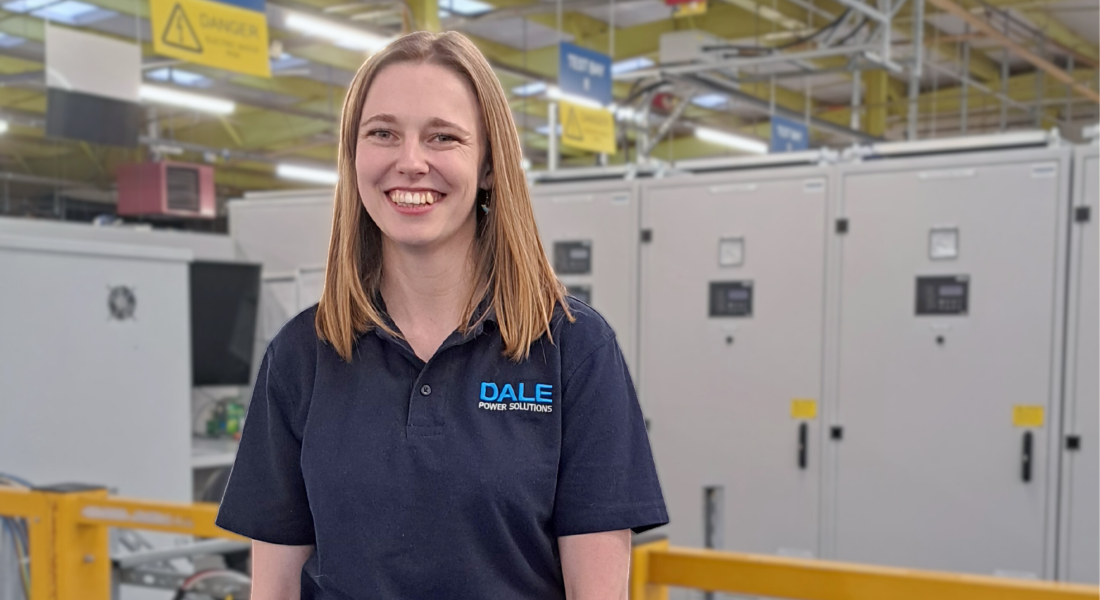
In this conversation, Sam Messruther, Industrial Uninterruptible Power Supply Sales Manager, discusses the challenges of grid modernisation, renewable energy integration, Battery Energy Storage Systems (BESS), and the role of DNOs, ICPs, and industrial UPS systems in supporting a more resilient and reliable energy network. Approaching an impressive 10 years with the business, Sam began her journey at Dale Power Solutions as a Higher Level (Level 4) HNC Engineering Apprentice straight from college, progressing into a key role within the company’s industrial power division.
Q: There is a lot of discussion around whether renewable energy is compatible with existing grid infrastructure. Do you think the grid is struggling to accommodate renewables, or has enough investment already been made?
I think it’s less about renewables being fundamentally incompatible with the grid, and more about the fact that the grid was originally built for a completely different level of electricity demand than we have today. When the network was first developed, electricity consumption across the population was significantly lower. Now we’ve got increased populations, internet infrastructure, Wi-Fi, data centres, electric vehicles and artificial intelligence (AI) all contributing to huge growth in demand. The amount of electricity we consume today is far beyond what the network was initially designed for. Demand forecast is also set to double in the next 10 years.
At the same time, the way we generate electricity is changing dramatically. Historically, the grid relied heavily on coal and gas-fired power stations. Those sources were much easier to control because if you needed more electricity, you simply burned more fuel and increased output. They were reliable, but obviously not sustainable in the long term.
Now we’re moving towards renewables and nuclear feeding into the system. Renewable energy overtook coal globally in the first half of 2025, and the future is clearly leaning further in that direction. The challenge is that renewable generation is naturally less predictable. It’s not always sunny when you need solar power most, and there isn’t always enough wind during peak demand periods. For example, electricity demand peaks tend to happen during prime-time TV ad breaks, when everyone puts their kettle on. Strictly Come Dancing runs on a Saturday evening during the Autumn and Winter, when renewables wouldn’t align neatly with those demand patterns.
So really, there are two major challenges happening simultaneously. First, we’re shifting from controllable fossil fuel generation to more variable renewable generation. Second, the infrastructure used to transport electricity around the country simply isn’t large enough in many places to accommodate the level of consumption we now have.
That’s why you now see things like overnight EV charging incentives. Suppliers are encouraging consumers to shift demand away from peak periods because if everyone plugged in their vehicles at exactly the same time, there simply wouldn’t be enough available network capacity.
Q: Why does renewable energy create additional challenges for grid stability?
The grid has to maintain a stable frequency at all times to avoid outages or instability. Renewable energy can create more fluctuation within the system because generation levels naturally rise and fall depending on weather conditions. Older infrastructure can struggle more with those fluctuations due to the need for storage.
People often think of the grid purely as energy generation, but really, the grid is just the transport network that moves electricity around the country. The issue isn’t necessarily renewables themselves, it’s how you balance generation, storage and distribution at the same time.
That’s where technologies like Battery Energy Storage Systems (BESS) become important. These large-scale battery systems allow renewable energy to be stored when generation is high and then released later when demand increases. Without storage, renewables become much harder to manage effectively at scale.
Q: How important is battery storage becoming within the energy transition?
BESS is becoming absolutely critical because it helps solve one of the biggest challenges with renewable generation, which is storing the energy until it’s actually needed. With coal-fired power stations, generation could be increased whenever demand increases. Renewables don’t work like that, so storage becomes the balancing mechanism.
A good example is the Hornsea 3 offshore wind project and associated storage developments. The BESS system there has a capacity of 600 MWh and a 300 MW power rating, which is equivalent to the daily power consumption of around 80,000 UK homes. Projects at that scale show how storage is becoming essential to making renewable energy viable long-term.
Renewables are still an evolving technology area, so there’s naturally a level of uncertainty around future planning and infrastructure requirements. BESS helps reduce some of that uncertainty by giving operators more control over when energy is used.
Q: There has been a lot of discussion around the Great Grid Upgrade and major infrastructure investment. What are your thoughts on that?
The Great Grid Upgrade is essentially the largest overhaul of the electricity network in generations. OFGEM has announced around £24 billion of investment, and a lot of that is focused on expanding and modernising the network to cope with future demand and renewable integration.
A simple way to think about the grid is like a road system. The transmission network is the motorway system, operated by companies like National Grid, SSE and Scottish Power. Then the DNOs are more like the A and B roads that distribute electricity locally, with companies such as Northern Powergrid, UK Power Networks and Electricity North West handling those areas.
The major transmission operators are carrying out large expansion projects to increase network capacity, and Dale Power Solutions is supporting many of those projects at a substation level with Industrial UPS. There’s also a wider energy security aspect to this investment. If we can generate more renewable energy domestically, we can reduce our reliance on imported coal, gas and electricity.
Q: What pressures are DNOs and ICPs currently facing?
There’s growing demand for smaller renewable projects to connect to the grid, particularly at a DNO level. A lot of businesses now want to develop smaller solar farms or renewable sites, but many are finding that local grid capacity simply isn’t available without upgrades.
That’s where ICPs are becoming increasingly important. They’re growing because there’s more need for smaller-scale grid connections and infrastructure development to support renewable projects.
It’s also important to understand that upgrading only the major transmission network isn’t enough on its own. If the smaller DNO-level infrastructure isn’t upgraded at the same pace, bottlenecks still exist further down the system. Everyone across the network has to modernise together.
A lot of our work in this sector involves UPS battery replacement, testing, servicing and long-term maintenance. As substations become more complex and electrification increases, the pressure to maintain resilience and reliability becomes much greater.
Q: What role does Dale Power Solutions play in supporting substations and grid resilience?
A major part of our role is supporting substations with Industrial UPS systems and resilience infrastructure. UPS systems are critical within substations because they provide backup power for essential systems during faults, outages or emergency situations.
One of the key functions is safe shutdown capability. In the event of an emergency or incident, substations still need enough backup power available to safely operate necessary systems such as control systems. Our Industrial UPS batteries are typically sized to support critical loads for around six hours.
Another very important function is operating circuit breakers. The UPS system needs to provide enough power to trip or open and close breakers safely during fault conditions. Without that resilience capability, substations would face much greater operational risks.
As demand increases and substations expand, operators also need to reassess whether their existing UPS systems are still appropriately sized. A system that only needed to support 10 Amps 15 years ago may now need to support significantly more load due to additional infrastructure and increased operational requirements.
For new builds, future growth also needs to be considered from the outset. UPS sizing shouldn’t just account for current requirements, but also future expansion and increasing electrification across the network.
Q: What do you think the future of the UK grid looks like?
The future is definitely moving towards greater renewable integration, more electrification and much larger infrastructure investment. Wind power is continuing to grow rapidly, coal generation is declining further every year, and energy storage will become increasingly important.
But it’s not just about renewable generation itself. The entire network, from major transmission infrastructure down to local distribution systems, needs to modernise together. It requires nationwide coordination and long-term planning to make sure the grid can support future demand reliably and securely.
There’s a huge amount of work happening across the industry right now, and resilience will remain one of the most important priorities as the energy transition continues.
The UK’s energy transition is not only changing how electricity is generated, but also how it is transported, stored and protected across the network. As renewable generation and electrification continue to increase, large-scale grid investment, energy storage and resilient infrastructure will become increasingly important. As Sam explains, ensuring reliability across both transmission and local distribution networks will require long-term planning, coordinated modernisation and continued focus on resilience technologies such as Industrial UPS systems and BESS.