Q&A with Luke Hargreaves: Commercial UPS Growth, Product Portfolio Expansion, and Partnerships
Blog
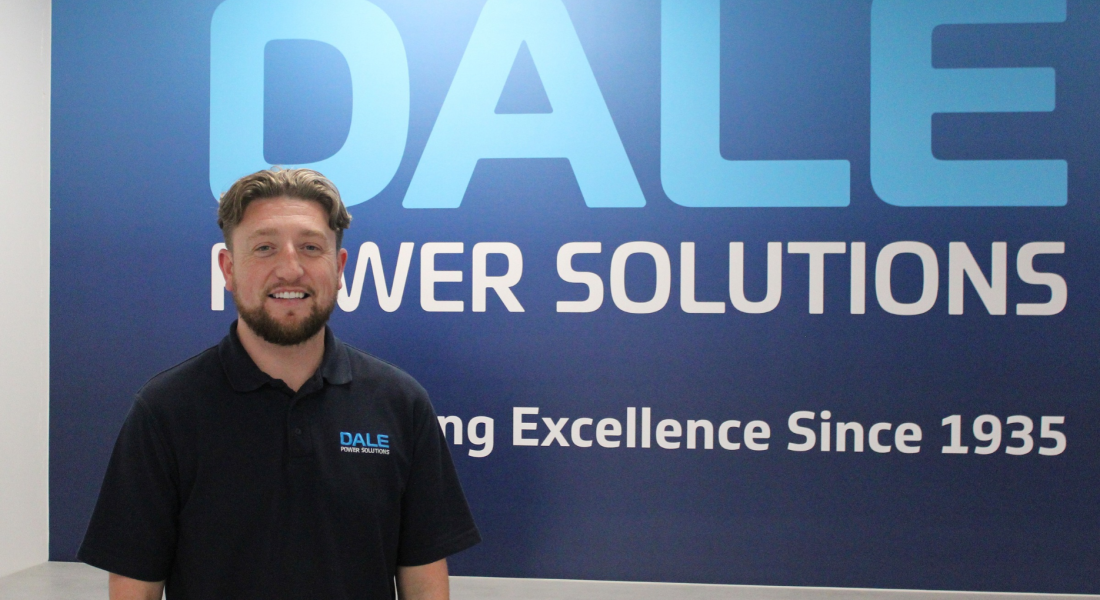
Luke Hargreaves has been part of Dale Power Solutions’ Commercial UPS team for just over two years, supporting business development and helping to grow Dale’s network of distributors, resellers and, more recently, facilities management and water utilities customers.
In this Q&A, we spoke to Luke about his route into critical power, the importance of customer relationships, the growth of Dale’s Commercial UPS offering and the opportunities he sees for continued growth.
Luke joined Dale with experience across the electrical market, giving him an existing understanding of many components found in critical power equipment. His move into Commercial UPS offered an opportunity to apply that experience to complete backup power solutions while developing a new area of business development for the division.
Q: What did you do before joining Dale?
I worked for an electrical components company, selling industrial components and switchgear. The Miniature Circuit Breakers (MCBs), contactors, and relays I used to sell are all components suitable for use in Dale’s industrial panels and industrial UPS systems.
So, coming into Dale, I already had a good level of electrical knowledge from that experience, although the critical power side was new to me. Previously, I was selling the individual components, whereas at Dale we’re providing the finished critical power solution.
Q: What attracted you to the business development role in Dale’s Commercial UPS team?
When I came for the interview and spoke to people here, it seemed like a really interesting opportunity. The Commercial UPS team hadn’t previously had a dedicated business development role, so there was an opportunity to help develop that side of the division.
Although it was a change in my career, I was still dealing with similar customers in the electrical market, so I could bring plenty of experience. I also saw opportunities for growth in terms of developing distributor and reseller partnerships.
Choosing the right backup power solution starts with understanding what the customer needs to protect, the site's requirements, and how critical systems must operate during a power disruption.
With access to Commercial UPS, industrial UPS, generators, battery energy storage systems (BESS) and service expertise, Luke can consider the wider requirements of an application rather than approaching every project with a single technology in mind.
Q: What does a typical customer journey look like, and how important is education within the sales process?
That’s an interesting one because, especially in this role, there can be a lot of different people involved in a project. An end user might have a facilities management (FM) provider or another organisation managing the site, for example. But we’re always happy to provide technical knowledge and help identify the right solution. When a UPS is providing reliable backup power, it’s essential that we get it right. That’s one of Dale’s strengths because we have our technical support team alongside expertise across our different product and service divisions.
The customer journey can vary depending on the sector, communication channel and the end user’s technical knowledge. Dale’s approach is always to understand the customer’s requirements, their site and any additional specifications so that we can provide the most appropriate solution.
Q: When do customers come to Dale, and what drives the decision to invest, and how does Dale ensure they get the right solution for their site?
If a customer has experienced a power failure, it often prompts them to approach us with concerns about backup power.
Critical power investment can sometimes be postponed until an outage demonstrates that need. During a power failure, emergency lighting must continue operating, lifts are part of a building’s evacuation strategy, and critical systems and data need to remain protected. An outage can really bring home the importance of power resilience.
Customers also don’t always know whether they need a UPS, a generator, or a BESS. That’s where we can advise them on what would be most appropriate for their application.
In some situations, for example, the size or noise associated with a generator may make it unsuitable, whereas smaller critical loads may be better suited to a Commercial UPS. In other applications, a BESS may provide the better solution.
Because Dale provides UPS, generators, BESS, and ongoing service support, we can consider the broader requirements rather than approaching each project with a single product in mind. These technologies can also be used together as part of a complementary critical power solution.
Our BESS division, for example, is currently supporting a water utilities project that the Commercial UPS team initially explored. Following a site visit, BESS was identified as the more appropriate technology for the application, particularly as the site was considering integrating solar PV into its wider critical energy and renewable infrastructure.
Developing Dale’s distributor and reseller network has been a major part of Luke’s role. Building on his previous experience in the electrical components market, this approach has helped the Commercial UPS division reach new customers, while the addition of product partners has further expanded the range of UPS applications Dale can support.
Q: Building Dale’s distributor and reseller network has been a large part of your role. How has that developed?
That came from a lot of experience in my previous role, where distributors and resellers were my main customer base. It wasn’t an area that Dale’s Commercial UPS division had traditionally focused heavily on, so I saw an opportunity there.
I proposed that it could be a good way to increase awareness of Dale’s products and reach more of the market while putting my experience working with distributors and resellers to use.
It’s been successful so far, and I’ve managed to bring several new partners on board, including YESSS Electrical and Kempston Controls. There can be a lot involved in managing relationships with organisations of different sizes and supporting the onboarding process, but it has become an important part of my role and led to key growth for the division.
Q: How do you make sure business relationships are successful?
I think it’s about staying close to the customer. My role coming into Dale was Business Development Manager, so naturally it’s about bringing in new business, but I’ve always understood business development to be relationship-led.
It’s something I’ve always been good at. Sometimes it can be as simple as helping somebody when they’re struggling to reach the right person within the company or making sure they get the information they need.
I think many customers stay with a business because of the relationships they build with the people there. I try to take a heavily relationship-led approach, and that helps with everything else going forward.
Q: How has the expansion of Dale’s GTEC product range supported Commercial UPS?
It allows us to meet more customers’ requirements, quote on more opportunities, and increase our market presence.
We’ve seen something similar through our partnership with Ablerex, which has opened additional opportunities, including emergency lighting applications. Expanding our product portfolio gives us more options when considering a customer’s specific requirements.
It’s also good to build strong relationships with our product partners. We’ve already seen the value of that through our partnership with Ablerex, and the addition of GTEC enables us to offer an even broader and more competitive Commercial UPS portfolio.
With a stronger distributor and reseller network established, facilities management and water utilities are becoming increasingly important areas of focus for Dale’s Commercial UPS team.
Both sectors have distinct critical power requirements, from maintaining essential building systems to protecting equipment within challenging water and wastewater infrastructure environments.
Q: Which sectors are key growth areas for the Commercial UPS division at the moment?
Having established a stronger reseller and distributor network, Dale's commercial UPS division sees facilities management and water utilities as two of the biggest opportunities.
Dale already works with FM providers through Commercial UPS and our service and maintenance teams, but with our expanded Commercial UPS product range through our GTEC and Ablerex product partnerships, we can now support an even wider variety of projects.
Similarly, in water utilities, we offer WIMES-specific IP54 UPS solutions designed to provide backup power in the challenging environments found throughout water infrastructure. With AMP8 underway, there is significant investment going into strengthening and improving the resilience of water infrastructure, so it’s an important sector for us to support.
Commercial UPS is a competitive market, making product choice, technical capability, customer relationships and brand recognition important to continued growth.
The expansion of Dale’s product portfolio provides more options for different applications, while the Commercial UPS team is increasingly focused on taking those capabilities directly to customers in key sectors.
Q: The Commercial UPS market is highly competitive. How does Dale differentiate itself?
It is a competitive market, particularly compared to the areas Dale operates in with our industrial UPS and generators, where systems can be much more bespoke.
For us, it’s about having a strong product range, competitive pricing and product features that meet customers’ requirements, including options with 10-year design-life batteries and true online double-conversion UPS technology.
A big part of the opportunity is continuing to build Dale’s brand recognition across different sectors. Once you’ve built that relationship and demonstrated the quality of the products and support available, it can become a long-term relationship.
Continuing to increase awareness of Dale and our Commercial UPS capabilities will help us make further headway in the market.
Q: What factors do you think will shape Dale’s growth in the Commercial UPS market?
For Dale, a big part of it is continuing to put the brand in front of the right people and ensuring customers understand our capabilities.
My increased focus on facilities management is part of that. It’s about getting out of the office, meeting customers, establishing relationships and increasing both our market presence and brand visibility.
There are also opportunities created by investment in sectors such as water, where organisations are considering the resilience and future requirements of their infrastructure.
Alongside new products, partnerships, and markets, Luke highlights Dale’s people and long-standing critical power experience as important parts of the business.
With colleagues across Dale reaching decades of service, that depth of knowledge sits alongside continued investment in new products, partnerships and areas of growth.
Q: What’s different about working for Dale?
The company is a great place to work. When you have so many people who have worked here for decades, I think that says a lot about the company and the environment people work in.
It’s also good to see Dale's success in recent years and to be part of a business with such a long history and a strong position in the critical power market.
Commercial UPS is an important part of Dale’s overall offering, and it’s exciting to have the opportunity to help drive the division’s growth and see where we can take it next.
Dale Power Solutions works with customers to understand their application, site and resilience requirements before identifying the appropriate critical power solution.
Our Commercial UPS team supports businesses across a wide range of applications, backed by wider expertise in industrial UPS, generators, battery energy storage systems, and ongoing service and maintenance.
A Commercial Uninterruptible Power Supply (UPS) provides backup power to connected equipment if the mains electricity supply is interrupted or falls outside acceptable parameters. Depending on the system, a UPS can also protect critical equipment against other power quality problems.
An online double-conversion UPS continuously converts incoming AC power to DC and then back to AC before supplying the connected load. This isolates critical equipment from many disturbances affecting the incoming mains supply while providing uninterrupted power during a mains failure.
A UPS can provide immediate backup power without the start-up period associated with a standby generator. Generators are typically suited to supporting loads for longer periods, while UPS systems can provide continuous protection to critical equipment. The two technologies can also work together as part of a wider critical power system.
WIMES stands for Water Industry Mechanical and Electrical Specifications. The specifications are used within the UK water industry to establish requirements for mechanical and electrical equipment used across water and wastewater infrastructure.
An Ingress Protection rating of 54 (IP54) means that an enclosure provides protection against limited dust ingress and against water splashes from any direction. This can make IP54 UPS solutions suitable for more challenging environments than standard commercial installations.
A Battery Energy Storage System (BESS) stores electrical energy for use when required. Depending on the application, BESS can support objectives including energy cost reduction, peak demand management, renewable energy integration and energy resilience.