Article
Does your uninterruptible power supply (UPS) need more attention than it used to? Does it seem like performance is degrading? Then you might not know what the next best steps are. Should you repair it, overhaul it or start planning for a new system?
The right answer depends on many factors and generally comes down to the following three possible outcomes:
You might carry out repairs to fix a problem that has occurred
You may plan overhauls to upgrade older components such as fans and capacitors before a larger issue appears
You could decide to replace the entire solution altogether.
In some cases, a repair or overhaul can do enough to keep you running as well as before. In others, replacing the UPS may give you much better performance and long-term value.
At Dale Power Solutions, we can help maintain and repair existing UPS solutions. But we can also suggest when a replacement could give you a better return on investment. In this guide, we’ll go over the common signs when repairing, overhauling or replacing your UPS might be better, helping you make the best decision for your site.
If your UPS is still relatively modern, supports your current load and has parts available, repair or overhaul work can be a good option. This is especially true when the issue is linked to normal lifecycle components, for example:
Batteries
Cooling fans
Capacitors
Firmware updates
Minor component repairs.
Regular UPS servicing can also help keep your systems healthy. It gives you a better view of battery health and component wear. It can also help you be proactive – spotting issues before they impact on business. The key to repairing is making sure the UPS still fits your site and has a realistic service life ahead.
UPS replacement becomes more important when repairs no longer solve the bigger problem. Likewise, if you’re managing older assets, you might find that components become obsolete with limited access to spares. If faults are becoming more frequent, parts are harder to source, or your UPS no longer meets your site’s needs, another repair or overhaul might essentially only buy you time.
A replacement may cost more up front than replacing or overhauling the existing UPS. However, it’s important to consider the Total Cost of Ownership (TCO). Consider that replacement costs may be offset by the many benefits a new solution could bring:
Reduced risk of future faults and costs of replacement
Simpler and more widely available support and components
A longer remaining service life
More efficient and reliable performance.
A sign that replacement may be needed is if your system is ageing and spare parts are becoming difficult to find. Likewise, if faults are happening more often or load requirements have changed, it may be time. For example, your TCO may show that improved energy efficiency may help offset the cost of replacement over time.
It’s also important to remember that investing now can pay off in the long term. Your new UPS may cost more, but it could deliver returns the old system couldn’t. Modern UPS solutions often deliver improved performance, higher reliability, and better efficiency, which can make the change worthwhile. At the same time, components should be more robust and easier to maintain going forward.
Consideration
| Repair or overhaul may suit you if... | Replacement may suit you if... |
Upfront cost | You need a lower-cost short-term option | You can invest now in return for longer-term reliability |
UPS age | The system is still within a practical service life | The system is ageing or close to end of support |
Fault type | The issue is linked to batteries, fans, capacitors or serviceable parts | Faults are repeated, major or harder to diagnose |
Spare parts | Parts are available within a fast timescale | Parts are obsolete, expensive or take a while (potentially many months) to source |
Reliability | The repair or overhaul will restore confidence in the system | The system remains unpredictable, even after repairs |
Efficiency | Running costs are still acceptable | Energy losses are becoming a concern |
Monitoring | Existing monitoring still meets your needs | You need better visibility and remote monitoring |
Future growth | Your current load is unlikely to change | Your site may need more capacity or redundancy |
Long-term cost | The work gives useful extra life to justify the cost | Repeated repairs are reducing the value of keeping the system and impacting profitability |
Before choosing repair, overhaul or replacement, it helps to get a clear picture of your current system.
First, check the system's age. This includes the battery age and condition, as well as the condition of individual parts. A commercial UPS typically provides around 10–12 years of service, although actual service life depends heavily on its design, operating environment, loading, maintenance history, and continued availability of manufacturer support. Beyond that, parts may be difficult to source, and more efficient modern models may be available.
Next, check your records to see whether faults repeat. Also check whether they’re becoming more frequent.
A key factor you may overlook is parts availability. Older systems may have hard-to-source or even obsolete parts, which can make repair more trouble than it’s worth. In some cases, parts for obsolete products may take months to produce.
It’s also a good idea to consult your efficiency benchmarks and see if the system is still performing as you need it to. If, after repair or overhaul, you’re not getting the results you need, replacement may be a good idea.
Finally, think about not only your current load requirements, but also your planned needs. If you’re scaling, or if your loads are increasingly critical, a new system may help protect your applications.
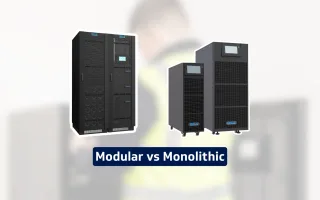
If replacement sounds like the better option, it’s worth thinking about the type of UPS that will suit your site. The replacement assessment should also consider whether a monolithic or modular architecture best suits the site's capacity, redundancy, maintainability and future growth requirements.
At Dale Power Solutions, we can help you decide whether UPS repair, overhaul or replacement is the right choice for your site. Our 85+ nationwide service engineers can review your UPS condition and history. We will then clearly explain your next steps and assist with replacement system design and project planning, where needed.
Dale’s commercial UPS portfolio includes a wide range of monolithic, modular, transformerless and transformer-based technologies. These are suitable for different applications and power requirements, suiting a range of sites. Our dedicated Commercial UPS facility in St Albans strengthens our project delivery, technical support, training, stockholding and aftersales capability, complementing Dale’s wider UK service network.
Contact our team today to learn more about your Dale or third-party UPS service and maintenance options.
Repairing or overhauling components of a UPS may make financial sense at first, especially if the system is still supported and parts are available. Along with regular servicing, this is usually enough to run reliably for the average 10-12 years of product life.
However, as a UPS ages, increasing maintenance costs, reduced efficiency or diminishing parts availability can make continued operation less cost-effective. In this case, replacement may offer better long-term TCO. The right answer will depend on your unique system and future plans.
A UPS’s lifespan is typically between 10-12 years and depends on factors like:
Build quality
Operating conditions
Load
Maintenance history.
In many cases, batteries and other lifecycle components will require replacement or overhaul before the UPS itself reaches the end of its practical service life. Regular servicing can help you plan for these replacements ahead of time.
In many cases, you can fix or upgrade an existing UPS. However, if it’s obsolete, unsupported or no longer suitable, replacement may be the better option.
Common warning signs that your UPS may need to be replaced include:
Trouble sourcing spare parts
Repeated faults
Poor efficiency
Difficulty meeting your current load.
If problems are becoming more frequent or costly, it may also be time to look at replacement options.
UPS batteries should be replaced when testing identifies deterioration, when they can no longer provide the required autonomy, or in accordance with the battery manufacturer's recommended service life. Actual battery life depends on factors including battery technology, ambient temperature, charging conditions, cycling and maintenance history. Batteries can normally be replaced independently of the UPS, where the UPS itself remains serviceable and supported.