Case Study: Dale Power Solutions Completes Generator Fuel System Upgrade for Healthcare Site
Case Study
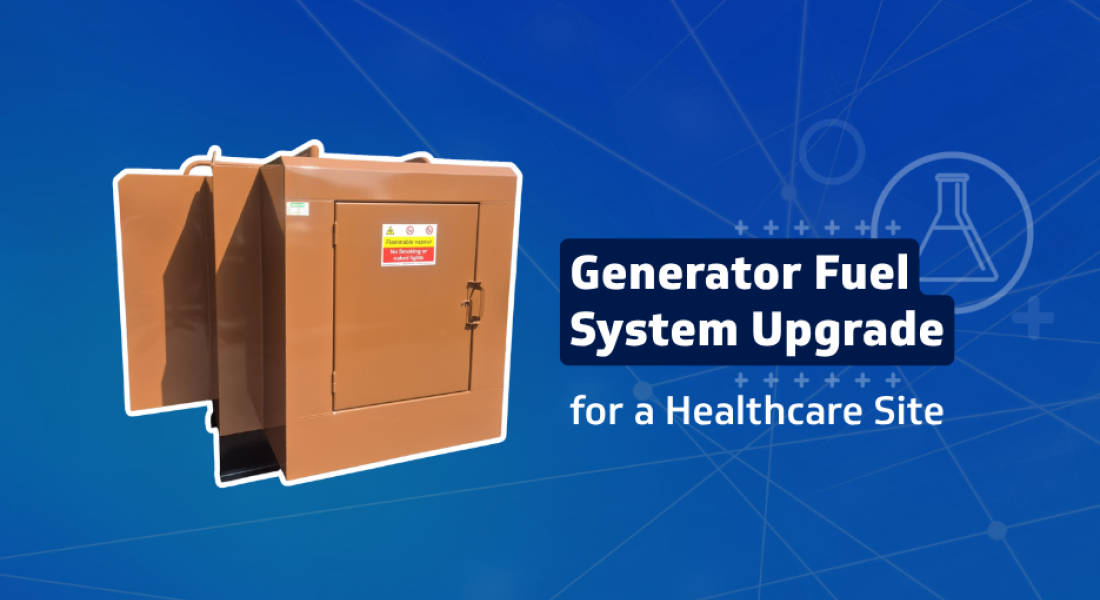
Dale Power Solutions has successfully completed a generator fuel system upgrade at a healthcare site, improving the reliability and resilience of its standby power infrastructure.
The project involved installing a generator day tank, along with new fuel pipework, fuel monitoring and leak-detection equipment, a fixed fuel-polishing system, and an upgraded control panel.
A key challenge was maintaining backup power resilience while the hospital’s existing generator was taken offline. To manage this risk, Dale Power Solutions coordinated temporary generation and completed blackout testing before the critical upgrade works began.
Project area | Work completed |
Generator day tank | New day tank delivered, lifted into position, fuelled and commissioned |
Fuel pipework | Double-skinned underground pipework installed |
Fuel monitoring | OLE gauge, bund probe and leak detection installed |
Fuel quality | Fixed fuel polishing system installed, tested and programmed |
Controls | Existing control panel upgraded, rebuilt and tested on-site |
Temporary power | Temporary generator installed and blackout tested |
Commissioning | Fuel system and hospital generator tested before final handover |
Reliable standby power is critical within healthcare environments, where interruptions to electrical supplies can affect clinical services, infrastructure and patient care.
The hospital’s generator fuel support system required an upgrade while maintaining suitable backup power throughout the works. This meant fuel tank installation, pipework modifications and electrical control improvements had to be carefully coordinated without unnecessarily increasing the risk to site resilience.
The programme involved Dale Power Solutions working closely with site contacts, the temporary generator supplier, crane lift contractors, fuel delivery services and on-site engineering teams.
NHS England’s Health Technical Memorandum HTM 06-01: Electrical services supply and distribution provides guidance on the design, operation and maintenance of electrical infrastructure within healthcare premises.
The required response to a loss of electrical supply depends on the clinical risk and the systems being supported. HTM 06-01 identifies standby generators as a secondary power source, while uninterruptible power supply (UPS) systems and batteries can provide tertiary supplies where required.
Depending on the application and clinical risk, some systems require a no-break supply or very rapid restoration, while other services can tolerate longer changeover periods.
This makes careful planning, system testing and appropriate contingency arrangements particularly important when carrying out work on healthcare standby power infrastructure.
Dale Power Solutions developed and coordinated a phased programme that allowed the fuel system upgrade to be completed while maintaining backup power provision for the healthcare site.
A temporary generator was installed and blackout tested. After successfully testing this contingency arrangement, the project progressed to the critical works affecting the hospital generator.
The new day tank was delivered to site and positioned on the prepared concrete foundation using a contract crane lift. Dale Power Solutions then completed the associated mechanical and electrical installation, including:
Double-skinned underground fuel pipework with leak detection;
An OLE fuel gauge with an additional bund probe and leak detection system;
A fixed fuel polisher to help maintain fuel condition;
New connections to the fire valve and generator solenoid to control the fuel supply;
Final fuel system, generator and blackout testing before handover.
Following installation, the upgraded generator fuel system was commissioned and tested before being handed over to the customer.
The hospital generator was reinstated and blackout tested using the new fuel tank and associated infrastructure, confirming that the completed system operated as required.
Careful sequencing of the works, temporary generation and coordination between the different project teams helped keep disruption to hospital operations to a minimum while allowing a significant upgrade to critical standby power infrastructure to be completed safely.
Dale Power Solutions will be exhibiting at Healthcare Estates 2026, taking place at Manchester Central on 13-14 October.
Visit Dale Power Solutions at Stand E23 to speak to our team about generators, UPS systems, fuel systems, maintenance and critical power solutions.
If you are attending and would like to arrange a meeting with our team, please email marketing@dalepowersolutions.com.
Our fuel services team supports reliable, resilient fuel infrastructure across healthcare and other mission-critical environments, providing expertise from initial assessment and system design through to installation, commissioning, maintenance and emergency support.
A generator day tank is a smaller fuel storage tank located near a standby generator. It provides a readily available fuel supply to the generator and can be part of a larger fuel storage and transfer system.
Fuel polishing is a process that cleans stored fuel by circulating it through filtration equipment. It can remove water, sediment and other contaminants that may affect fuel quality and generator reliability.
Blackout testing simulates a loss of normal electrical power to confirm that standby power equipment and associated systems respond correctly. In critical environments such as hospitals, testing is an important part of verifying that backup arrangements operate as intended.
Double-skinned pipework uses an inner fuel-carrying pipe surrounded by a secondary outer layer. The additional containment, often combined with leak detection equipment, helps identify and manage potential fuel leaks.
HTM 06-01 is NHS England guidance on the supply and distribution of electrical services in healthcare premises. It covers electrical infrastructure, resilience, standby power, and the safe operation of healthcare electrical systems.
Temporary generation can provide an alternative standby power source while existing generator equipment is offline for planned maintenance. The temporary equipment should be appropriately specified, installed and tested as part of the project's contingency arrangements.